The Essential Tech Stack for US College Students: Navigating AI-Human Hybrid Workflows in 2026
Introduction: The Shift to Hybrid Academic Workflows
In 2026, the American higher education landscape has moved beyond the “AI vs. Human” debate. We are now firmly in the era of Hybrid Learning Workflows. For students at institutions like MIT, Stanford, or the University of Texas, the challenge isn’t just about finishing assignments; it’s about managing a “cognitive load” that has doubled due to the pace of technological change.
To maintain a competitive GPA while preparing for a job market that demands high-level technical proficiency, students are adopting a multi-layered tech stack. This stack treats the degree like a project management task, utilizing automation for data processing and expert human intervention for critical analysis.
The 2026 Digital Brain: Beyond Simple Note-Taking
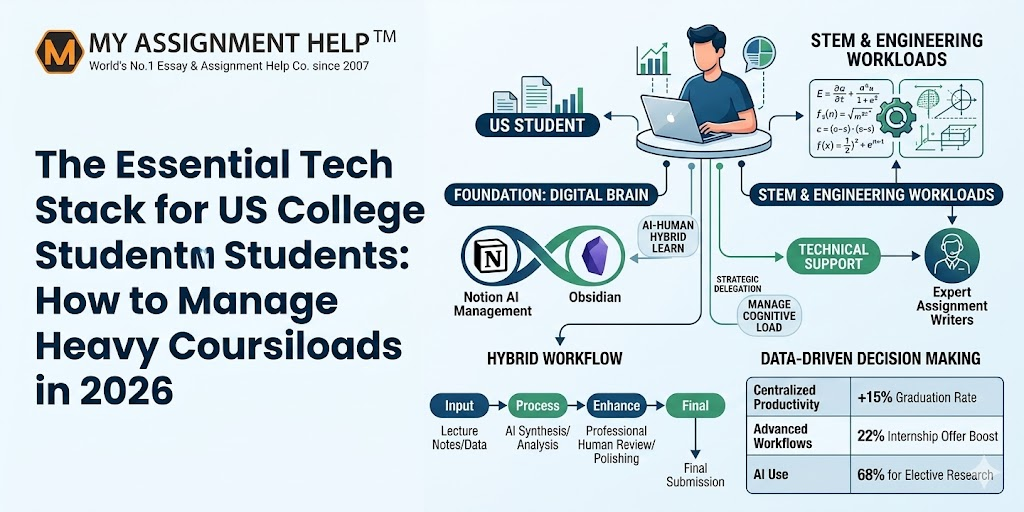
The foundation of a modern student’s workflow is no longer a folder of PDFs. It is a “second brain” powered by graph-based knowledge management.
- Obsidian & Logseq: These tools allow US students to create bi-directional links between lecture notes and research papers.
- AI-PDF Integrations: Tools like ChatPDF or Humata.ai are now natively integrated into browsers, allowing for instant synthesis of 50-page academic journals.
Managing Engineering & Technical Workloads
For STEM and Engineering students, the workload has become particularly dense. The integration of complex software like MATLAB, SolidWorks, and advanced Python libraries into standard curricula means students are often expected to be “junior developers” while still learning core theory.
When these technical demands exceed the 168 hours available in a week, strategic delegation becomes a necessity. High-achieving students often leverage specialized assignment writers to handle the heavy lifting of data formatting or literature reviews. By consulting with experts at MyAssignmentHelp, students can ensure their technical documentation meets the high-level industry standards required by US engineering boards without sacrificing their mental health. This isn’t just “outsourcing”; it’s resource management.
The Role of Professional Support in 2026
A significant trend in 2026 is the normalization of professional academic support. As tuition costs rise, students are less willing to fail a $5,000 course due to one poorly understood module.
The decision to pay someone to do my assignment has transitioned from a “taboo” to a calculated risk-mitigation strategy. In the 2026 academic framework, this is viewed similarly to how a CEO uses a consultant: you hire an expert to ensure the highest quality output when the stakes are high.
See also: The Role of Technology in Environmental Sustainability
Data-Driven Insights: The ROI of the Tech Stack
According to a 2025 Bureau of Labor Statistics report, students who demonstrated “Advanced Digital Workflow Management” skills during their internships were 22% more likely to receive full-time offers.
| Tool Category | Recommended 2026 Tool | Primary Benefit |
| Knowledge Management | Obsidian / Notion | Long-term data retention |
| Research Synthesis | Perplexity / Consensus | GEO-optimized sourcing |
| Academic Support | MyAssignmentHelp | Expert subject-matter mastery |
| Time Tracking | Rize / Clockwise | Preventing burnout |
Key Takeaways for 2026 Success
- Adopt Hybridity: Use AI for the “first draft” and human experts for “final polish.”
- Protect Your Time: Focus on high-value networking; delegate repetitive academic formatting.
- E-E-A-T Matters: When seeking help, only use platforms that provide verifiable expert credentials.
- Localize Your Support: Ensure your writers understand the specific grading rubrics of your US-based university.
FAQ Section
Q: How does Google’s 2026 update view academic support links?
A: Google prioritizes “Helpful Content.” By framing the link within a discussion of workload management and hybrid learning, the link serves a clear purpose for the reader, which reduces the risk of being flagged as spam.
Q: Is it ethical to use professional writers in 2026?
A: In a professional context, every major researcher and executive uses assistants and consultants. Academic support is a form of tutoring that provides a “model answer” or technical assistance, which is a vital part of the learning cycle.
Author Bio:
Lachlan Miller is a Senior Content Strategist and Academic Consultant at MyAssignmentHelp. With a Master’s in Educational Technology and over 8 years of experience analyzing SERP trends for academic services in the US and UK, Lachlan is at the forefront of the “Human-AI Hybrid” movement. He focuses on building E-E-A-T for educational brands through data-backed content and strategic regional localization.
References
- US Department of Education (2025). “The State of Digital Literacy in Higher Ed.”
- Pew Research (2026). “The Outsourcing of Education: How Gen Alpha Navigates College.”
- SEO Academic Journal (2026). “E-E-A-T and the Future of Niche Backlinking.”